Charlotte’s Tangled Web

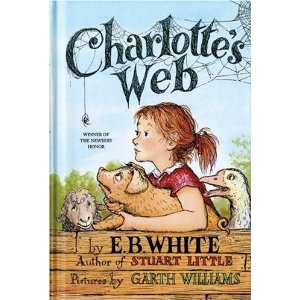
Just finished reading Charlotte’s web to my son, out loud, for the third time. You probably remember the story — a barnyard spider named Charlotte’s saves a pig named Wilbur’s life by weaving words into her web. I love this book every time I read it.
Charlotte’s Web is a story about selfless love, and it also describes, with a lot of elegance, the messiness of living and loving.
Bloodsucker
There’s a famous Hindu saying that goes, “I am food. I am eater of food. I am food.” Wilbur meets Charlotte when he’s feeling desperately lonely. Thought she will later become his best friend and save his life, he is at first put off by her “bloodthirsty” and “cruel” livelihood. Charlotte defends herself this way, “I am not entirely happy about my diet of flies and bugs,” says Charlotte, “but it’s the way I’m made . . . My mother was a trapper before me. Her mother was a trapper before her . . . You have your meals brought to you in a pail . . . I have to get my own living . . . lest I go hungry.”
The Power of Advertising
For a barnyard tale, Charlotte’s web is also a tale of the power of advertising. The scheme that Charlotte devises to save Wilbur’s life — writing words into her web to describe Wilbur — “some pig”, “terrific”, “radiant”, “humble” — depends on the gullibility of humans who believe what they read. The only clear-eyed human in our story is Mrs. Zuckerman who — upon first hearing of the web — remarks that “the spider is the real miracle.” And she is promptly ignored.
Friendship
A great deal of mutual affection exists between Charlotte and Wilbur, but the friendship is quite one-sided. Wilbur is self-absorbed, childish, and needy (a Spring pig, after all). For the most part, he’s completely unaware of Charlotte’s needs. He pesters her when she’s trying to come up with the scheme to save him. He insists that she come to the fair with him, even when she has let him know that she’s tired and needs to weave an egg sack. She goes, and dies there, far from home.
In the end, Charlotte’s often one-sided love for Wilbur is a redemptive love. Through loving him, she redeems, in part, her blood-sucking existence, and that, in itself, is a gift.
“Why did you do all this for me?” Wilbur asks Charlotte on their last day together. “I don’t deserve it. I’ve never done anything for you.” “You have been my friend,” replied Charlotte. “That is itself is a tremendous thing. I wove my webs for you because I liked you. After all, what’s a life, anyway? We’re born, we live a little while, we die. A spider’s life can’t help being something of a mess, with all this trapping and eating flies. By helping you, perhaps I was trying to lift up my life a trifle. Heaven knows anyone can stand a little of that.”
The Rat
Templeton the rat is the most despised character in the book — completely self-centered, driven by sensual pleasures (i.e. eating) and completely without humor. Nevertheless, Wilbur and Charlotte’s survival is entirely dependent on Templeton at critical moments. Templeton hides the rotten goose egg that saves Charlotte from Avery Arable with its stink; he fetches words for Charlotte to write in her web (though Charlotte has a tremendous vocabulary, she apparently has no idea how to spell); he bites Wilbur’s tail when he passes out in the middle of his award ceremony at the county fair; and finally, he retrieves Charlotte’s egg sack from the pig pen so that her babies can come home to the Zuckerman barnyard. The barnyard animals tolerate Templeton’s presence among them, even though they know, as the goose and gander do, that he would steal one of their goslings if he could.
Lessons
So what are the (perhaps unexpected) lessons that we might glean from Charlotte’s web? Here’s what I’d venture:
1) Love has no logic. Love the ones you love, whether they deserve it or not. Don’t be surprised if someone loves you whose love you don’t deserve. Loving is its own reward.
2) People are stupid: understand who they are, not who they’re supposed to be.
3) Tolerate the enemy (in you and around you): he might just save your life.
Just came across a wonderful account of why E.B. White wrote Charlotte’s Web.